Monday, October 8, 2018

Hello 太太 | London


Palace Street


Rutland Gate in Knightsbridge


Location:

Previously reported:
“2-8a Rutland Gate is in the process of being acquired by funds advised by the Family Office of Mr Cheung Chung-kiu”. Chung-kiu, better known as CK, is a Hong Kong-based billionaire who owns a string of property companies, including CC Land Holdings. He owns part of the former Whiteleys department store in Bayswater and 122 Leadenhall, the triangular-shaped skyscraper in the City of London better known as the Cheesegrater and worth more than £1bn. However, CK was never the ultimate owner of 2-8A Rutland Gate. He appeared to be, according to Land Registry filings, just a frontman – but more of that later. 

Now:

The house has lain empty since the auction, even after its record-breaking sale in 2020, purportedly to Chung-kiu, the Hong Kong property billionaire. However, it is in fact owned – very indirectly and offshore, of course – by his Chinese poker club buddy and fellow Chinese property billionaire Hui Ka Yan. He is the founder and majority shareholder of Evergrande, a Chinese property empire that declared bankruptcy in 2021 and is now restructuring its $270bn debts.

Hui’s estimated personal fortune hit $42bn in 2017, making him the second richest person in Asia and among the top two dozen wealthiest in the world.

Rich people from China started moving to London after the handover of Hong Kong in 1997, with numbers increasing dramatically in the 2000s. In 2021 a record 650 high net-worth individuals – classed as those with cash assets (not including their home and its contents) of at least £10m – moved from China to the UK.

Since then the Chinese property bubble has burst and Hui’s wealth has plummeted to about $3bn, causing him to fall off Bloomberg’s list of the world’s 500 richest people. In urgent need of cash to stave off the collapse of his empire, Hui has been disposing of an array of assets, including two luxury Chinese apartments and two private jets. Now this London mansion and his 60‑metre super-yacht Event are on the block.

In Hong Kong,Evergrande's hq was taken over by receiver; and has failed to sell

https://www.bnnbloomberg.ca/evergrande-s-hong-kong-headquarters-taken-over-by-a-receiver-1.1817977

Battersea

Selfridges Sold to Thai & Austrian Interests

A Hotel is Coming

https://www.dailymail.co.uk/money/markets/article-10356513/New-Selfridges-owners-plan-luxury-hotel-site-flagship-Oxford-Street-store.html


Heady days of retail Selfridge's and Harrod's pre-Covid 

    📸: Hello 太太

RETAIL 💔

Selfridges and Harrods Lay Offs


Brown Thomas Lay Offs


Marks & Spencer

Marks & Spencer plans to cut about 7,000 jobs over the next three months after its clothing business was hit hard by the coronavirus lockdown 
https://www.bloomberg.com/news/videos/2020-08-18/marks-spencer-to-cut-around-7-000-jobs-video
https://pages.pagesuite.com/5/a/5a53b8ff-5b36-4a79-a2dd-d43cc2530d62/page.pdf


Cockpit footage from a flypast by the RedArrows to mark the 75th anniversary of VE Day. Several London landmarks in sight as the Royal Air Force Aerobatic Team paid tribute

Notes:

The Walkie Talkie Building

In 2017, Lee Kum Lee bought 20 Fenchurch for $1.7 billion USD

Our tour of the interior of 20 Fenchurch [double click the link]

📸 Andrea Eng

📸: Hello 太太

SHKP in London

The Kwok family and Ballymore have made a huge bet on the London residential market by buying a £1bn skyscraper scheme in the Isle of Dogs, E14
Through its controlling stake in listed developer Sun Hung Kai Properties, the Hong Kong family has bought two connected sites from Galliard with planning consent for six towers rising to 44 storeys in a joint venture with the Irish developer.
In total, the 898-home 6-8 South Quay and 615-home 3 Millharbour, collectively known as Millharbour Quarter, will deliver 1,513 homes on the Millwall Dock.
The pair paid £50.8m for the sites, according to the Land Registry, through the companies Great Eastern Nominee 1 and 2, and which list Sean and John Mulryan of Ballymore and board members of Sung Hung Kai as directors...
Alongside their investment into Lillie Square with Capco at Earls Court, they announced another tie up with Ballymore in 2017 to become partners in the Goodluck Hope scheme in Poplar, a riverside development of 800 homes.
MORE > https://www.egi.co.uk/news/kwoks-and-ballymore-in-1bn-canary-wharf-resi-push/

The Wealthiest Property Owners In The UK

1. David and Simon Reuben, £15.096bn

These India-born brothers initially made their money from aluminium, but poured their fortune into London’s booming property market. They own a mass of top-end real estate in the capital including Westminster’s Millbank Tower and John Lewis’s head office, near Victoria Station. They also have prime sites in Mayfair, Kensington and the West End - including the former premises of the Naval and Military Club, which they are now turning into a luxury hotel. Now in their late 70s, the pair were last year tipped as potential buyers for Newcastle United Football Club.

2. The Duke of Westminster and the Grosvenor family, £9.964bn

The 7th Duke inherited his title on the death of his father two years ago - and with it oversight of 300 acres of Belgravia and Mayfair. He and his family also own land and property in Oxford, Cheshire, Scotland and Spain. Other assets include nearly 165,000 acres of rural land, a dairy farm and the UK’s largest bull stud operation.

3. Sir David and Sir Frederick Barclay, £7.4bn

Best known for owning London’s exclusive Ritz Hotel and the Telegraph newspaper, the Channel Island-based twins also own the massive retail operation Shop Direct. The Barclays made more than £2bn from the sale of the Maybourne Group of hotels - which included the world famous Claridge’s. They live in a gothic castle on the Channel Island of Brecqhou.

4. Earl Cadogan and family, £6.7bn

The Cadogan family have owned nearly 100 acres of Chelsea and Kensington for 300 years. Almost 50% of the £6bn portfolio is retail space, mostly around the chichi shopping destinations of Sloane Square and the King’s Road. The rental income at the family’s main business grew by 10% to £142.7m in 2016.
A two-bedroom flat for £1.5m above the shops on the famous King's Road in Chelsea. The Earl of Cadogan and his family own much of the retail space here and in Sloane Square.

5. Sir Henry Keswick and family, £4.782bn

Hong Kong conglomerate Jardine Matheson has interests ranging from property and hotels to food and cars. Much of its wealth stems from its operations in China and it has a £35.2bn value on the stock market. The Keswicks have a holding worth nearly £4.7bn.

6. John Grayken, £4.763bn

This American investor is pouring money into an area near Wembley Stadium. His Quintain property company has plans for 7,000 homes and London’s biggest Boxpark – a foodie heaven selling dozens of different delicacies from around the world. Grayken also owns a $35m penthouse in his home town of Boston, Massachusetts.

7. Baroness Howard de Walden and family, £4.015bn

A 92-acre estate of Marylebone has been in the de Walden family since 1879. Their tenants include much of Harley Street’s private medical community and chichi shops on Marylebone High Street. Sixty members of the de Walden family own stakes in the main company. 

8. Ian and Richard Livingstone, £3.8bn

After selling a chain of opticians, these two brothers went into property development. Their recent ventures have included some eye-catching Hollywood homes and a £6bn development in Panama. They also own hotels in London, Ibiza, Barbados and Monte Carlo. 

9. Eddie and Sol Zakay, £3.42bn

Student accommodation is the next investment for the Zakays, who have won approval for a £100m scheme in Wembley. The pair made their money from dozens of property deals with Tesco, Marks & Spencer and other retailers. The Israeli-born brothers also own hotels.

10. Mark Pears and family, £3.245bn

The Pears’ £6bn property portfolio is said to house 1% of the UK’s workforce. Rising rents and the £10m sale of a Bloomsbury property have increased their wealth over the past year. Members of the family are understood to have made $100m from the stockmarket float of Facebook. 

11. Samuel Tak Lee and family, £3.037bn

This Hong Kong billionaire owns a big stake in property company Shaftesbury, which owns a large part of London’s Carnaby Street and Chinatown.  

12. Richard Desmond, £2.6bn

After selling Express Newspapers, Desmond is hoping to win the National Lottery franchise. He has been involved in property developments worth around £1bn. 

13. Teddy Sagi, £2.6bn

The Israeli gaming entrepreneur owns London’s Camden Market and recently bought the capital’s Bupa House for £70m. 

14. John Whittaker and family, £2.25bn

A Lancashire-born property mogul, Whittaker has overseen vast developments across the North West and owns a big chunk of retail park business Intu.   

15. Viscount Portman and family, £2.002bn

The Portmans own 110 acres of London real estate in central London and 500 residential properties. 

16. Sheikh Hamad Bin Jassim Al Thani, £2bn

This Qatari investor was one of the main backers of the Candy Brothers’ One Hyde Park development – where apartment prices started at £20m.  

17. The Lazari family, £2bn

This Greek Cypriot family own 2.8m square feet of commercial real estate and 113 residential properties, mostly in London.  

18. John Bloor, £1.858bn 

A former plasterer from Derbyshire, Bloor made a fortune from housebuilding and has also revived the Triumph motorbike brand. 

2019 June 2019   FINANCIAL TIMES

Is now the right time to buy property in London?

Lottie Bodilly has just bought her first home. After months of searching, the 25-year-old, together with her partner, Jackson, has found a large two-bedroom apartment in a Victorian building in Streatham, south-west London. The couple completed last Friday. The price: just under £500,000. 
“The vendors had a lot of interest and we had to go to sealed bids,” says Bodilly, a web publishing entrepreneur. “We moved quicker than we would have liked because the market was a little sparse and we were nervous about how many more homes were going to come up for sale. But we liked it,” she says, “so we went for it.” 
If Bodilly had waited, would she have got a better deal? The property market in London is in turmoil. In the first three months of this year, prices were down 4 per cent on the first quarter of 2018, according to Nationwide, and 5 per cent down on their peak the year before. 
In January, the number of homes sold fell to its lowest in a decade. Last week, shares in Foxtons, the London-focused estate agency, were trading at about 53p, down 87 per cent since their peak in 2014. All this with Brexit unresolved, and a no-deal exit on 31 October still possible. If that were to happen, house prices could drop 30 per cent in the next three years, according to the Bank of England stress test’s worst-case scenario.
But Bodilly is undeterred. “Neither of us are particularly concerned about Brexit,” she says. “This is our first house and we’ll probably be here for three to five years at least, so we were more concerned that we wanted to buy in an area that was going to come up.” 
Many property agents and experts agree with her. They say early indicators suggest the slump in London’s housing market may be about to end. This, of course, is exactly the kind of thing estate agents like to say, so how can we be sure? The answer, of course, depends on your circumstances, but let us look at the evidence to help you decide whether to make a move — or wait it out:

What the data show

The seasonal nature of the housing market makes spotting short-term trends difficult, and the recent fall in transactions makes it even harder. Still, there is some evidence the market in London could be about to turn. The proportion of London homes with falling values peaked last autumn at about 80 per cent, according to Zoopla, the online property portal. By the beginning of 2019, that proportion had fallen to 68 per cent. The proportion of homes showing monthly falls has dropped below 30 per cent for the first time in tin two years.
The fall in prices may be slowing, too. According to Rightmove data released this week, average asking prices are still lower than where they were a year ago in 28 of London’s 32 boroughs. However, 23 boroughs are now reporting monthly increases. Based on a rolling three-month average, asking prices were up 2.3 per cent in Westminster at the beginning of June, compared with the beginning of May — up 1.5 per cent in Haringey, and 1.2 per cent in many boroughs, including Kensington and Chelsea.

These are only asking prices — and they may be inflated by pricey new developments in those areas — but there is evidence that sellers are setting more realistic prices. According to Richard Donnell, head of research at Zoopla, in mid-2014 the median asking price of a home new to market in London was between 20-25 per cent higher than the median selling price. By the end of last year that gap had closed.

Sellers have less time to wait for a deal, too. The average selling time seems to have peaked, according to data from Rightmove. In May a home spent an average of 72 days on the market before selling; down from 89 days in January.
Luxury homes have been hardest hit during the housing downturn. Prices of central London’s prime properties — which account for the top 5 per cent of the market by value — have fallen by more than 19 per cent since 2014, according to Savills. But again, these are falling more slowly this year. In the first three months of 2019, prices were level in Mayfair and Kensington. 
Over the past five years they have fallen 24 per cent and 21 per cent respectively. In Notting Hill and Holland Park — both of which have seen price falls of more than 15 per cent since 2014 — transaction numbers have increased and prices have risen, albeit by less than 1 per cent.

What the agents say

“After such a large adjustment — even greater in international currency terms — London is starting to look like pretty good value,” says Lucian Cook, director of Savills Research. “And very good value in comparison to its competing world cities.”
Tired of waiting, buyers have decided to push ahead, says Tom Bill, head of London Residential Research at Knight Frank. In the first quarter of this year, Bill says his agency received the highest number of offers on homes in prime central London for 10 years, and in April, it reported 8.2 new buyer registrations for every new instruction across London — the highest ratio for 15 years. 
“Buyers have been watching the market for value and holding off,” he says. “But only up to a point can they hold out. Now they want to make a decision — and they’re looking beyond Brexit.”
“People are a little bit bored of talking about Brexit,” says Simon Hedley of Druce and Co, an estate agent based in Marylebone in central London. He says stamp duty reforms of 2014 and 2016 have had a much bigger effect on the market. They increased the tax bill on all homes priced above £937,500 and added a 3 per cent premium on second homes. 
Nine out of 10 of Hedley’s buyers have to pay this premium, he says. On a property price of £2m, the stamp duty rate is now 3.7 percentage points higher than it was before 2014 — an additional cost of about £74,000. But it is not all bad news for buyers: according to Savills, prime prices in Marylebone have fallen 7.8 per cent since 2014, meaning that buying the same property now, including the increased stamp duty, should still result in a net saving of more than £105,000 on the total cost in 2014.

What the developers say

New developments may be particularly exposed to property market fluctuations because they tend to be more speculative purchases and are popular with international investors. “Since spring there has been a surge in demand from owner-occupiers for some of the best apartments in our developments,” says Gabriel York, co-chief executive of Lodha UK. 
The Mumbai-based developer has two luxury projects in London: Lincoln Square, a development of 221 homes near Lincoln’s Inn Fields, where a one-bedroom flat costs £1.6m; and One Grosvenor Square, a development of 48 homes in Mayfair, where two-bedroom apartments start at £8m. 
York was unable to give the latest sales numbers to the FT, but as of 31 March this year, Lodha had sold 12 homes at One Grosvenor Square and 146 at Lincoln Square, according to Moody’s. According to Vikas Halan, senior vice-president at the rating agency, London sales in the nine months to December 2018 were only half what Moody’s expected — a factor in its decision in May to change Lodha’s outlook to negative. 

So is now the right time to buy property in London?

If prices in prime central London recover, the effect will probably filter down into what Lucian Cook calls London’s “wealth corridors” — those swaths of smart homes that radiate from central London into areas such as Fulham, Wandsworth, Chiswick and Islington. However, despite there being the general belief among estate agents that benefits will trickle down — because that is what happened after the financial crisis, the last time house prices slumped — that may not be the case this time, says Neal Hudson director of Residential Analysts. 
“There has not been any real correction in the wider London market,” he says. “In fact, it looks like more of a stagnation that correction. The big transaction falls happened a couple of years ago and now the number of sales are just bumping along at very low levels and house price growth is kind of going sideways.” 
Affordability has barely budged and, thanks to stamp duty reforms, and the removal of certain tax breaks for landlords, there are far fewer buy-to-let investors in the market than there were five years ago.
“We are probably at peak first-time-buyer pricing, given that mortgage rates and lending criteria are where they are,” says Hudson. 
How likely are they to change? At present, mortgage lenders are required to limit the amount they lend above the 4.5 times-salary threshold to 15 per cent, says David Hollingworth of L & C Mortgages. “Lenders must demonstrate borrower affordability, so there isn’t necessarily any great growth in the amounts that the majority of borrowers can secure without growing income,” he says.
“I’m not necessarily convinced it is a good time to buy,” says Hudson. “Not least because there are still massive political and economic risks in the event that something stupid happens with Brexit. The risks of waiting six months are minimal.” 
But waiting is not right for everyone. Lottie Bodilly and her partner would have certainly lost out on a flat they loved if they had not committed to buying it. They can afford the mortgage repayments and they intend to stay for a while. 
If you put your life on hold in the search for conclusive proof that the property market has reset itself, be prepared to wait for a long time indeed.

https://amp.ft.com/content/235efd34-8eaf-11e9-a1c1-51bf8f989972?__twitter_impression=true

2022

FT (£)  “The Scalpel’s owner, US insurance group WR Berkley, is in the final stages of talks with property investor Ho Bee Land and a deal for roughly £820mn could be signed off as soon as this week.”

https://www.ft.com/content/cf455a27-be1e-4d17-9090-39cee3ee7178


Chinese retreating [but other Asians are replacing them]

https://www.bloomberg.com/news/articles/2022-02-15/london-property-news-chinese-developers-are-retreating-from-the-u-k-capital?sref=b6L8VQ8T

2019

Largest Transactions 2018


太太:
1. The Diamond is next to the Gherkin which I almost bought for tycoon Richard Li four years ago - I was first in line with the Receiver before international financier Safra bought. Management at Pacific Century Premium Developments, killed the deal; I had already retained legal team to represent us. We would be ahead by ~ $500 million USD by now. #timingiseverything
2. Lai Sun's co-investor in The Diamond include our UBC classmate who is Vice Chair of Asia Standard, a respectable medium size publico in HK with holdings globally. In Vancouver, Asia Standard is developing the former 'Cloud 9' site on Robson Street

SINGAPORE | Districts 9,10, 11

Districts 9, 10, 11

As at 2023 April 07:


Nassim is still my favourite

Singaporeans loving the luxury homes foreigners can't buy

Some of Singapore's most desirable houses come with a catch: only locals can own them.

That foreign buyers - notably from China - who for years helped drive demand for luxury homes, can't buy these dwellings, hasn't dented their appeal. Their scarcity and the exclusivity they confer have pushed prices of the homes - known as Good Class Bungalows, or GCBs - to record highs, even as the broader property market cools.

Just about 2,500 GCBs dot the city-state, ranging from colonial-era houses to architect-designed modern homes with cantilevered verandas, infinity pools and expansive landscaped gardens, a world away from the high-rise condos most Singaporeans call home.

In a recent blockbuster deal, Tony Tung, the chairman of Hong Kong-based oil trader Winson Group, bought a bungalow near the Botanic Gardens for S$105.3 million, the Business Times reported earlier this month, saying it was a record for a GCB. Nearby, a Singaporean member of the Tsai family, who made their fortune in insurance in Taiwan, snapped up a bungalow for S$93.9 million.

More records may soon be broken. A new bungalow near the Botanic Gardens, featuring a central courtyard pool and water garden, will soon hit the market with an asking price of S$3,500 per square foot. That would surpass the previous record of S$2,700 per square foot set last year, according to KH Tan at Newsman Realty, who is handling the sale.

"Due to scarcity and exclusivity, the GCB market has always been regarded as the jewel of the residential market and a coveted trophy asset to the well-heeled community," said Sammi Lim, director of capital markets at real estate agency CBRE Group Inc. "GCBs have proven to be a resilient asset class through market cycles."

That's proving to be the case again as a rally in home prices stalls following the imposition of further property curbs in the middle of 2018. House values declined 0.1 per cent in the three months ended Dec 31, snapping five straight quarterly gains.

The citizenship requirement isn't the only restriction on GCBs. The plot must be at least 1,400 square meters, and the house can't take up more than 35 per cent of the land, or be more than two stories high. Such luxurious use of space is another status symbol in one of the world's most densely-populated countries, where about 7,900 people are crammed into each square kilometer.
Singapore is also one of the wealthiest nations on Earth - home to the ninth-highest number of millionaires - according to Credit Suisse Research Institute's 2018 Global Wealth Report.

That's helped underpin activity in the GCB market, with the number of transactions rising 47 per cent in the second half of 2018 compared with the first six months of the year, according to CBRE.

Typical buyers are super-wealthy locals, and foreigners who have attained citizenship, said Mr Tan, managing director at Newsman Realty, which specialises in bungalow deals.

"The super rich want to buy the best diamond, the best car, so in Singapore residential, the Good Class Bungalow is the best you can get," Mr Tan said.

BLOOMBERG  
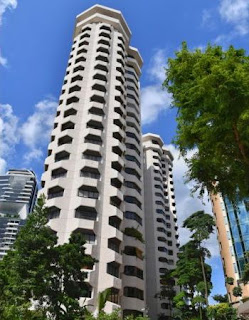
HighPoint sits on a site in a cul-de-sac in Mt Elizabeth Road. It comprises 57 apartments and two penthouses. More than 80 per cent of the owners have signed the collective sale agreement. The site is zoned "residential", with a height control of up to 36 storeys.  


Freehold development in Mt Elizabeth Road seeks S$550 million, joining a clutch of other District 9 sites

Prime freehold site HighPoint has been launched for collective sale for S$550 million, joining other District 9 developments jockeying for sale.

The property, which was completed in 1974, sits on a cul-de-sac plot of approximately 47,606 sq ft on Mount Elizabeth Road.

In the Urban Redevelopment Authority's Masterplan 2014, the site is zoned as "residential" with a height control of up to 36 storeys.

The existing gross floor area (GFA) stands at around 211,976 sq ft, equivalent to a plot ratio of around 4.45. No development charge is payable up to a GFA of approximately 213,383 sq ft.

Based on the guide price, the land rate works out to about S$2,595 per sq ft per plot ratio (psf ppr). Taking into consideration the seven per cent bonus gross floor area for balconies, the land price works out to about S$2,509 psf ppr.
Assuming an average apartment size of 100 sq m, the site can accommodate up to 196 dwelling units, said marketing agent CBRE.

HighPoint currently comprises 57 apartments and two penthouses. More than 80 per cent of the owners have signed the collective sale agreement.
The development is within walking distance of ION Orchard, Paragon and Mount Elizabeth Hospital; nearby schools include Anglo-Chinese Junior School and the Orchard campus of Chatsworth International School.

The public tender for the site closes on Feb 26 at 3pm.

Galven Tan, executive director (capital markets) at CBRE, said: "The potential 36-storey height will offer panoramic views, featuring the lush greenery of Goodwood Hill and the CBD skyline.

"Its exclusivity presents immense potential to create a one-of-a-kind Orchard Road landmark which will attract ultra-premium developers. Overall supply in the ultra-luxurious segment of the market remains very limited, and we believe the interest and pricing will continue to hold firm."

The site piqued the interest of some Hong Kong-based foreign developers looking to invest in Singapore during its pre-marketing exercise, he told The Business Times.

"The site has the attributes which tick the boxes on their checklists to develop a premium product in line with their branding," he added.

Other developments in the same district that have been put up for collective sale include the 99-year leasehold Leonie Gardens, which is going at a reserve price of S$800 million.

The freehold Cavenagh Gardens is taking another shot at selling en bloc at a reserve price of S$480 million.

Meanwhile, Horizon Towers on Leonie Hill Road last week relaunched its collective sale tender at a S$1.1 billion reserve price, unchanged from its attempt last July. That round closed in September without attracting any bids.

The condominium was previously put up for collective sale for S$500 million around 2007, but that sale to a consortium led by Hotel Properties Limited fell through after a dispute among the owners. Eventually, the Court of Appeal found that the sales process was improperly handled.

This time around, JLL is its sole marketing agent.

Commenting on the Horizon Towers and HighPoint sites, JLL's executive director of capital markets (Singapore), Tan Hong Boon, said: "Both are prime sites, with their own attributes. Horizon Towers has more scale in terms of physical size and quantum, so the economies of scale are better."

But he pointed out that HighPoint is a freehold site, against Horizon Towers' 99-year tenure.

He further noted that there could be some overlap in potential developers looking at those two sites.

Horizon Towers' S$1.1 billion reserve price translates to a land rate of about S$1,977 psf ppr after factoring in the lease top-up premium, which is estimated to be some S$228 million, or S$1,797 psf ppr inclusive of the 10 per cent bonus gross floor area (GFA).

There is no development charge or differential premium for intensified use of the 1.9 ha site.

The estate, built in the late 1970s, is zoned "residential" in the 2014 Master Plan with an allowable height of up to 36 storeys.

It is about 150m from the upcoming Great World MRT station, and offers dual road accesses to Leonie Hill and Leonie Hill Road.

Other sites in District 9 which were put up for en bloc sale last year and for which there were no takers include The Regalia in River Valley and Elizabeth Tower in Mount Elizabeth Road.


MONTREAL

TORONTO


TRENDS

The Mink Mile - Bloor Street

Toronto’s Yorkville neighbourhood has come a long way from the 1960s, when cheap rents for its Victorian row houses attracted artists and trendsetters who populated the area with galleries and music clubs that featured up-and-coming talents such as Gordon Lightfoot, Joni Mitchell and Neil Young.
Today, the Bloor-Yorkville area’s eclectic low-rise streets are ringed by high-rise office and condo towers whose tony retail tenants including Holt Renfrew, Gucci, Birks and Tiffany – and attract so many fashionistas, the zone is nicknamed the Mink Mile.

According to a new study by Chicago-based commercial real estate brokerage Jones Lang LaSalle Inc. (JLL): “The luxury stretch of Bloor Street West between Yonge Street and Avenue Road boasts Canada’s highest retail lease rates, which averaged in 2019 about $285 a square foot, putting Bloor Street ahead of Robson Street in Vancouver (at $225 a square foot) as well as in line with upscale streets such as Newbury Street in Boston, and Lincoln Road in Miami.”

High-end retail experience is pushing its boundaries

With its abundance of luxury retailers, the area is nicknamed the Mink Mile.
Wallace Immen/The Globe and Mail
The affluence of this retail location influences nearby streets, spilling north to the area’s namesake Yorkville Avenue.

Turns out this northern stretch of Yorkville Avenue between the Hazelton Hotel at 118 Yorkville Ave. and Bellair Street has seen rents nearly double over the course of three years, currently averaging between $250 and $275 a square foot, JLL found.

By comparison, leases on Toronto’s Queen Street West average $100 a square foot, Robson Street in Vancouver $225 and Saint-Catherine Street in Montreal $210, JLL reports. Of course, those numbers pale in comparison to New York’s upper Fifth Avenue, where rents can reach US$2,720, the Beverly Hills triangle in Los Angeles that can command US$1,100 and Oxford Street in London where prime rents are the equivalent of US$775.

Growth in upscale shopping area isn’t an accident

Yorkville’s launch into the upper echelons didn’t happen by accident, though. Even a few years ago, there was speculation that with shifts in retailing toward more online shopping and a retrenchment of brands that the zone north of the Mink Mile would fall into decline.
Yorkville was getting decidedly shop worn by 2011, when First Capital Properties, a subsidiary of First Capital Realty Inc., acquired Hazelton Lanes, a 1970s shopping mall at the corner of Avenue Road and Yorkville Avenue.

To pump life into the area, First Capital developed a long-term vision for Yorkville that started with a total renovation of the old mall – to give it more street presence. The redevelopment also allowed for a rebranding and the mall became known as Yorkville Village.
First Capital rechristened Hazelton Lanes as Yorkville Village.
Over the past eight years, First Capital has purchased and reconfigured several stretches of Yorkville Avenue where Victorian homes had been converted to shops in the 1970s and 80s. The property redevelopment and management firm also took a majority position in the Hazelton Hotel, which was redesigned and relaunched as a preeminent luxury boutique hotel that is at the core of Yorkville’s luxurious experience.

“We are reinventing ourselves every day,” says Gregory Menzies, executive vice-president of First Capital Realty Inc., and project lead for Yorkville Village.

“Yorkville is almost a perfect storm, where you have tremendous amount of density and tremendous amount of high-net worth,” Mr. Menzies says.
With the number of condo units in the area expected to double in the next two years, Yorkville retailers can tap into an expanding base of potential customers.
Wallace Immen/The Globe and Mail
There are about 11,000 condominium units in the immediate area and that’s destined to double in the next two years based on what is planned for the area and what is currently under construction.
Add to this the tourism and the business community along Bloor Street and the University of Toronto, and the area is rich in potential customers, Mr. Menzies says.

Trend in high-end retailing requires ongoing community support

In the past, many brands shifted their flagship stores into enclosed malls, but there’s now a shift back to brands – particularly the higher-end and exclusive name brands – having their main flagship stores at street level in Yorkville, the JLL study found.
For example, the 102-108 Yorkville Ave. block of properties, which are new builds done by First Capital Properties, boasts flagships of many of fashion’s most exclusive names, including Brunello Cucinelli’s largest North American store at 8,200 square feet spread out on three levels of retail space and Versace with two floors of retail space totalling 3,000 square feet.
.
.
.
Chanel's Toronto flagship store is housed in a heritage structure that was once home to Mount Sinai Hospital.
First Capital/Handout
According to the new report, the Canadian luxury apparel market will increase by 5.8 per cent in 2019 and by 18 per cent from 2019 to 2023, to reach $3.2-billion in sales within the next five years.

More importantly, report authors predict that the luxury sector growth rate will be nearly twice that of the overall clothing retail sector.

That should translate into more luxury store demand for Yorkville, Ms. Lemm says.
“It is an incredibly exciting time for Bloor-Yorkville,” she says. “There has been a real renaissance to the area that will continue to propel other luxury interest and activity and help to continue the growth of this destination-shopping area.

Top 10 Transactions of 2018

https://renx.ca/top-10-cre-transactions-toronto-2018/
By Kelly Roche


The top two transactions

Topping the chart in 2018 was the sale of a 50 per cent interest in downtown Toronto’s Bay Adelaide Centre, owned by Brookfield Properties (BPY-UN-T ). Private firm Dadco investments paid $850 million for its share of the property. 
“That’s one of the best assets in Canada,” Wong said.
British-Canadian businessman Victor Dahdaleh, who heads Dadco, made the investment in March. The 51-storey, 2.2-million-square-foot property takes up an entire city block in the heart of the financial district at 333 Bay St.
“It ranked as the biggest transaction in Toronto last year,” said Wong.
A redevelopment site deal came in just behind, at No. 2. Bombardier sold the Downsview airport site at Dufferin St. and Sheppard Ave. W., to PSPIBDownsview Investments (Public Sector Pension Investment Board) for $825 million. 
At the moment it’s unclear if the ICI land will continue to be used for industrial or manufacturing. Wong predicts possibly seeing a mix of commercial, office and retail in the next five to 10 years as the site is redeveloped. 

What’s driving buyers, sellers?

They were by far the two largest transactions during 2018, a year when Wong said investment activity remained at a constant level. He cited three key motivations for investors and sellers:
Focusing on core assets or core investment strategy. For instance, RioCan REIT (REI-UN-T) has decided to focus its retail and redevelopment efforts in major markets such as Toronto, Vancouver, Montreal, Edmonton, Calgary and Ottawa “and less so . . . on the tertiary markets.” 
Value-add. Investors seeking real estate or investment properties to which they can add value, such as improving an existing asset. For example, Timbercreek‘s acquisition of an apartment portfolio from the Wynn Group: “They’re looking to invest into those apartment buildings to increase potential rental rates or returns off of those properties.”
* Realizing gains. “They’re acquired this asset over a number of years and they’re looking to take some profit off the table,” said Wong. He offered the $850-million deal for Bay Adelaide Centre as an example: “In that situation, it’s perfect for Brookfield because they still manage the premises and they’re also taking some profit off the table, and they’re still getting the revenue from being able to manage the facility and as well as own half the asset.”
Here are the rest of the Top 10 GTA transactions, according to Altus data:

3. Lakeview Lands

Lucrative South Mississauga lands make two appearances in the Top 10 transactions, including the Ontario Power Generation sale of the Lakeview Lands for $275 million. The buyer was Lakeview Community Partners Limited, a consortium comprised of TACC ConstructionGreenpark GroupCCI Development GroupBranthaven Homes, and Argo Development Corporation.
Locally, the brownfield site is referred to as the “Four Sisters,” a nickname spawned by the chimney stacks which stood above the former generating station. Lakeview was one of five OPG coal-fired power plants shut down to reduce the province’s greenhouse gas emissions. 
The lands are located at 800 Hydro Rd., east of Cawthra Road and south of Lakeshore Road E. The 177-acre site is being transformed into a mixed-use community with parkland.

4. Queen’s Quay Terminal

Queen’s Quay Terminal at 207 Queen’s Quay West was sold by Brookfield Properties to Quebec City-based iA Financial Group for $261 million. Wong called it an opportunity to “pick up a really good asset” in Toronto.

5. Parkway Place

Tigra Vista Inc. paid $256 million to acquire North York’s Parkway Place from Agellan Commercial REIT (ACR-UN-T). The deal for the office space at 235-245 Consumers Rd. is among a trio of the GTA’s 10 largest transactions which were sealed during the fall. 

6. 55 University Ave.

Back in the downtown, Cominar REIT (CUF-UN-T) sold office space at 55 University Ave. to Investors Group for $195 million. Cominar’s strategy “last year was basically to focus on core assets,” said Wong. 

7. 3575 Elgin Mills Rd.

Pemberton Group acquired 3575 Elgin Mills Rd. in Markham for $187 million in April 2018. The residential land play means “they’re looking to develop those lands down the road,” Wong said.

8. Starlight buys Wynn Group portfolio

The Wynn Group sold the Riverside Apartments in Etobicoke to Starlight Investments for $183 million. The property is at 2737 and 2757 Kipling Ave. “I think they were looking at opportunities to be able to improve that site or improve that asset,” said Wong.
(Riverside is part of the Wynn Group / Starlight Investments’ GTA Apartment Portfolio, which consists of nine total properties — eight in Toronto and one in Brampton. The portfolio was purchased for $402,137,237 and contains a total of 1,527 residential units, representing an aggregate price per unit of $263,351).

9. Dixie Outlet Mall

Cominar REIT made the Top 10 a second time with its sale of Mississauga’s Dixie Outlet Mall. The 406,000-square-foot retail property at 1250 South Service Rd., was sold to Slate Asset Management in a $181 million transaction. The mall is located just south of the QEW between Cawthra Rd. and Dixie Rd.
“They’re probably looking at all different options at this point,” Wong said, to improve the site or increase returns. “Right now, I think it’s going remain retail.”

10. West Lodge Apartments

The Wynn Group sold its West Lodge Apartments in Toronto to Timbercreek Asset Management for $170 million. The properties are at 103 and 105 West Lodge Ave. It was also part of a larger portfolio transaction, which included 21 properties across Ontario.     -  2019 Jan 2019

Toronto | Office


The World's hottest Luxury Market


The Canadian city of Toronto was the hottest luxury real estate market in 2014, bucking a slowing trend in the world's top property hubs, according to a new report from Christie's International Real Estate.


In 2014, year-on-year luxury real estate sales slowed in the nine of the world's top 10 property markets, which top-end international realtor Christie's ranked by sales prices, average prices per square foot and number of luxury sales. Homes priced at $1 million or more were classed as "luxury."  -  CNBC


MORE FACTS:

Other

Harbourfront

The challenges of connecting Toronto's south core
This community is shooting skyward with creative upgrades at street level and below

http://www.theglobeandmail.com/report-on-business/industry-news/property-report/the-challenges-of-connecting-torontos-south-core/article16209321/


While the skyscrapers of Toronto’s booming south core show no signs of slowing their climb, the equally impressive work taking place at and below ground level is what will define the area.

About 1.6 million square feet of new office space has been added to the south core market in the past five years. New developments under construction will inject a further 23,000 workers and almost another 10,000 residents into the already teeming south core district. As a result, infrastructure has never been more important to the area, particularly one that has undergone a dramatic role change

Bordered east-west by Bay and Simcoe streets, the south core area stretches south from the railway tracks that run along Front Street to the shores of Lake Ontario. “So part of the revitalization of the waterfront is creating infrastructure that serves more modern, mixed-use communities rather than the type of infrastructure that was needed when the waterfront was a busy industrial port,” Mr. Knoeck adds.

The Toronto waterfront is currently halfway through a 25-year redevelopment plan that is now estimated to cost approximately $34-billion, twice its original budget. In addition to surface-level improvements for residents and visitors – with a particular emphasis on the 2015 Pan Am Games – it also includes less visible but equally vital improvements underground. Many of the aging sewer pipes in the area will be replaced – nearly 20 per cent of all sewer pipes in Toronto are more than 80 years old.

Toronto Hydro is also doing its part with a $195-million transformer station being built under the west side of the railway roundhouse next to the Rogers Centre. Set to open in 2014, the Clare R. Copeland transformer station is the first built in the downtown core by Toronto Hydro since 1955, and will add 144 megawatts of capacity, enough to power 70 condominium towers, while freeing up the company’s 64-year-old Windsor transformer station at Wellington and John Streets for a needed equipment upgrade.

As Tanya Bruckmueller, spokeswoman for Toronto Hydro, puts it, “A lot of the infrastructure, including our station, is significantly past its life expectancy.”

While some in the real estate business warn that a lack of infrastructure could be the undoing of the downtown core, the rapid growth of the south core makes it a prime target for investment.

“I don’t know of another place in Canada where you’ll have this much employment [in] office buildings, a very significant number of new and existing residential units, a tremendous amount of new retail being added at the base of most of these buildings, obviously there’s entertainment in the Air Canada Centre and Rogers Centre – it’s all here,” says Dermot Sweeny, president of Sweeny Sterling Finlayson & Co Architects Inc.

Mr. Sweeny is one of the architects on the One York Street and Harbour Plaza Residences project, a mixed-use development costing more than $550-million on the south side of the Gardiner Expressway consisting of a 35-storey office tower and two high-rise condominium buildings that will open in 2016. While One York is a collaboration between Menkes Developments and the Healthcare of Ontario Pension Plan, which will be a tenant in the tower, the two residential buildings are being jointly developed by Menkes and Oxford Properties.

The design of One York Street threw up a unique infrastructure challenge when Mr. Sweeny was asked to extend Toronto’s indoor PATH walkway system south of a rather large obstacle – the Gardiner, a crumbling, controversial elevated expressway that dates back to the 1950s. Teaming up with the architects from Oxford Properties, WZMH Architects, who are developing the Royal Bank of Canada’s Waterpark III building to the south of One York Street, the collective knew the importance of making a successful PATH connection – RBC stated it wouldn’t go forward without it.

As Peter Menkes, president of the commercial/industrial division of Menkes Developments, put it, “Any downtown tenant that’s from the traditional King and Bay area, to come to this location, expects to have a PATH connection.”

Unable to go underground owing to low-lying sewer systems and with going above the Gardiner ruled out as it would have put the walkway 20 metres in the air, Mr. Sweeny and his fellow architects responded with a novel concept by planning for the PATH to go under the Gardiner but above Lakeshore Boulevard. Because of the constant need to keep up the concrete underbelly of the Gardiner, the PATH connection will be built on gaskets so it can be moved sideways and still be usable while repairs are going on.

The south core portion of the PATH will come further into focus once the redevelopment of Union Station is complete. Canada’s busiest transportation hub is undergoing a massive facelift which conservative estimates peg at anywhere between $700-million and $1-billion.

“For the first time ever in the history of Union Station it will actually have an entrance that faces south,” says James Parakh, acting director, urban design for the City of Toronto planning division. “That’s important because we can easily get pedestrians from Union Station or from the TTC subway down into this neighbourhood very conveniently.”

One York Street and the Harbour Plaza Residences project will also help to improve that neighbourhood for those pedestrians. With the developers paying rezoning fees under Section 37 of the Planning Act, the City of Toronto now has the funds to follow through on its plan to adjust the layout of the Gardiner Expressway and other roads in the area.
The Gardiner off-ramp that originally deposited vehicles gradually at Bay and York streets will now terminate more sharply at the foot of Lower Simcoe, allowing the freed-up area to the east to be used as green space with a widened eastbound Harbour Street.

“That was the whole intent,” Mr. Parakh says.“We had done a study many years ago, long before the Menkes application, that took a look at removing that ramp and of course Menkes, as part of their approval, provided Section 37 contributions by way of funds that removed that ramp.

“So it’s sort of a win-win. If that ramp is not needed, it’s a great location for a park, right in close proximity to the waterfront.”

Despite concerns that the new layout will increase congestion in the area when it’s finished around 2016, Jared Menkes, director of development for Menkes, believes the opposite, and says that the city’s new “Live Work Play” mantra is firmly in play. “A lot of people are moving downtown because they want that urban lifestyle, they don’t want the car,” he says. “So I think from a car perspective it’s going to ease that congestion but I think foot congestion is going to continue to grow."


Millionaire's Row on University Avenue


The Shang in Toronto


Rosedale 
My sister-in-law in Toronto is downsizing and listed their Rosedale home for sale

Saturday, December 9, 2017

Singapore Developers

SINGAPORE TRENDS


Because of rising demand, a number of En Bloc units have offered themselves as sites and finding purchasers


Here are the developers who were able to secure sites during 2017


The most noteworthy transaction is tycoon Robert Kuok's Allgreen Properties re-entry to the  Singapore market with this month.
.
.
.
Global Investments
Andrea Eng
Profile: andreaeng.com