Tuesday, June 10, 2014

Vacant Units


Vacant Condo Syndrome Happening Elsewhere


PUBLISHED JUNE 10, 2014
Dark condos shine light on rising vacancy
Suburban areas worst hit; softening rentals seen
As dusk descends upon the Singapore skyline, the excess capacity building up in the private housing market is evident. Dark patches in some condominium developments completed six to 12 months ago, or even longer, point to significant vacancy - PHOTO: REUTERS
[SINGAPORE] As dusk descends upon the Singapore skyline, the excess capacity building up in the private housing market is evident. Dark patches in some condominium developments completed six to 12 months ago, or even longer, point to significant vacancy.
Analysts cite a host of factors, including strong investment demand for real estate after the global crisis, escalation in private home completions of late, and slower expatriate inflow. Vacancies are set to climb and rents fall in general. Suburban locations, where most of the supply is, will be the worst hit.
"If increasingly there are a lot of empty units," says Lee Lay Keng, DTZ regional head (SEA) research, "it could indicate we're not making the best use of our limited land resources."
After the global crisis, investors sought refuge in trusty assets such as real estate. Fuelled by the low interest rate environment, some took to hoarding property at new launches and are hence not bothered whether they can find a tenant after taking possession of their units, say observers. Some high net worth foreign buyers treat their Singapore property as a holiday home and leave it unoccupied most of the time.
But there are others who leave units vacant because they are not able to find tenants. As Ms Lee notes: "Competition for tenants is increasingly intense, with both demand and supply factors at work. On the demand side, changes in labour policies have slowed down the flow of foreign professionals into Singapore while on the supply side, there is a higher-than-average number of private home completions."
JLL national director Ong Teck Hui highlights that "those who bought for rental returns would find themselves in a more competitive leasing market today, where units in mediocre locations would be more difficult to lease and therefore remain vacant for a longer duration, especially during this period of strong supply".
Ku Swee Yong, CEO of Century 21, explains that those who acquired private homes, say in 2010, would already be sitting on profits. "If they bought for capital gains, they may prefer to keep their unit empty rather than rent it out because it is quite usual for a fresh tenant to have a clause in the lease agreement protecting them from viewings by the landlord in the first six or even 12 months."
R'ST Research director Ong Kah Seng says that, due to low rents, some owners have left their units empty, especially the cash-rich set who did not take any housing loan for their purchase. "A vacant unit may deteriorate faster but leasing it out at a low rent may not be feasible since it will incur high maintenance costs. High-end properties have the finest finishes, so maintenance and repair costs may be hefty. Selected fit-outs and finishings such as tiles may be of limited collection and difficult to replace if it is damaged by the tenant."
Developers left with unsold units, especially in the slow high-end segment, also contribute to vacancies as these projects are completed. Other factors may also be at play in specific projects. But the overall trend of rising vacancies and softening rents is clear amid climbing private home completions since last year.
The 13,150 private homes that received TOP last year was 27.3 per cent above the previous year's 10,329 and 40 per cent above the past 10-year average of 9,395. The figure for Q1 this year was 4,114 and the full-year tally is expected to hit 17,138, based on estimates submitted by developers to the Urban Redevelopment Authority. Thereafter, completions are slated to climb further to 21,738 next year and 26,252 in 2016 before easing the following year.
URA figures show that the pool of vacant private homes has risen to 19,284 at end-Q1 2014 from 18,003 at end-Q4 2013 and 14,532 at end-Q1 2013. The islandwide vacancy rate rose to 6.6 per cent at end-Q1 this year from 6.2 per cent a quarter earlier and 5.2 per cent at end-Q1 2013.
CBRE executive director (residential) Joseph Tan says that the latest quarter's increase could be due partly to families that had yet to move to the new homes that were completed in Q1.
Rising vacancies have been accompanied by softening rentals. For the first time since Q3 2009, URA's private home rental index contracted in Q4 last year. The index dipped 0.5 per cent quarter-on-quarter, followed by a further 0.7 per cent drop in Q1.
CBRE predicts a 5-8 per cent drop in rents generally this year. JLL predicts a 4-8 per cent decline; Century 21's Mr Ku reckons competition for tenants will drive rents down by 8-10 per cent, followed by a further drop of up to 25 per cent in 2015.
Against the backdrop of the large supply, says DTZ's Ms Lee, some landlords could become more flexible on their rents, particularly after the removal of the vacancy tax refund with effect from Jan 1, 2014. "Landlords now have to pay property tax on their vacant units and some may accept a lower rent and have the unit rented out instead of leaving it empty."
This could create downward pressure on rents.
JLL's Mr Ong predicts the vacancy rate could be around 7-9 per cent at end-2014.
Mr Ku reckons vacancy will head towards 7.5-8 per cent mid to late next year, adding that price drops are likely to be limited to 5-10 per cent per year - assuming the economy is fine.
Competition for tenants is likely to be more intense in suburban projects, as the bulk of completions last year as well as the potential supply pipeline are in Outside Central Region (OCR). URA's Q1 rental index for non-landed private homes in OCR was down 2.3 per cent from a year ago. This compares with a decline of 0.3 per cent for Core Central Region (CCR) and a rise of one per cent in Rest of Central Region (RCR).
Of the 67,507 homes under construction at end-Q1, about 59 per cent were in OCR, 22 per cent in RCR and 19 per cent in CCR. Four years earlier, of the slightly over 36,000 units under construction, the respective shares were 30, 36 and 34 per cent, notes JLL's Mr Ong. "The heavy buying in OCR in the past few years has resulted in units under construction in this submarket surging 270 per cent over the past four years. While it is true that a high proportion of purchases in OCR is for owner-occupation, the level of investment purchases in the past few years has also been substantial.
"Based on rental contracts registered last year, OCR's share of the leasing market was about 31 per cent. Hence, the disproportionate oncoming supply may be expected to impact on this submarket more significantly."
Ms Lee, too, expects a bigger impact on rents and vacancy rates in the suburbs, "although rental demand will still be supported by budget-conscious foreign professionals as the rental quantum for suburban condos is lower than city-fringe or prime condos".

22 Percent of Chinese Homes Are Empty Says Research Study


China’s housing market is locked in a three-way face-off between developers who can’t sell new homes, speculators sitting on empty properties bought for high prices, and first-time home buyers who can’t enter the market because of housing costs that outstrip earning power.
These opposing forces add to the risks of sharper downturn in housing prices, according to a study released this week by the China Household Finance Survey and Research Centre at the Southwestern University of Finance and Economics in Chongqing.
Based on a survey of 262 counties in 29 provinces across China, the study found that the amount of unoccupied homes climbed from 20.6 percent in 2011 to 22.4 percent last year, totalling an estimated 49 million empty housing units.
In addition to the 49 million sold but vacant units, the survey estimated that China has another 3.5 million unsold homes sitting in developer’s inventories.   -- 2014 June 11 MINGTIANDI


Wednesday, May 7, 2014

Local


" ~ a quarter of all overseas investments and construction and engineering projects undertaken by Chinese companies from 2005 to 2014 - worth $246 billion - have been stalled by snafus or failed"   >> MORE


  • $3.5 billion 'blup' in Bahamas  >> details  >>  $50K to see sales package
  • Members clash with Chinese owners of Wentworth Golf Club  > more clashes
  • Overpay in Hong Kong - 'immature money management


  • SCMP


    Development Overseas Not Easy


    Global Monopoly doesn't mean applying same template everywhere

    PUBLISHED MAY 24, 2014
    Sentosa Cove villas relaunched at a discount
    Developer Ximeng Land giving 5% discount for remaining 12 luxury villas on Pearl Island


    BRAND NEW
    Each villa on Pearl Island comprises two storeys in addition to a roof terrace and basement. Absolute prices vary from about $14.3 million to $25.5 million per villa. 


    XIMENG Land, controlled by mainland China parties, is relaunching the balance 12 luxury villas on Pearl Island in Sentosa Cove at $2,185 psf on land area. The price is inclusive of a 5 per cent discount to the $2,300 psf list prices for the units. A year ago, the developer's asking price was $2,400 psf.
    Absolute prices vary from about $14.3 million to $25.5 million per villa. Pearl Island is one of the five man-made islands in the upscale waterfront housing district.
    "These are the last remaining brand-new luxury villas in the island developments in Cove, fully fitted and ready for occupation," said Steve Tay, associate director at Newsman Realty, which was last month appointed sole marketing agent for the villas.
    Since 2010, Ximeng has sold seven of the project's 19 villas at prices ranging from $1,904 psf to $2,228 psf on land area. The buyers comprise Singaporeans, Indonesians and mainland Chinese. The seven units sold include two adjacent units bought by members of the Liu family that controls Ximeng Land. One was purchased for $17.1 million or $1,904 psf on land and the other, for $19.5 million or $1,906 psf. The highest absolute price achieved for the seven sold units was $27 million (translating to $2,162 psf), for a bungalow on 12,486 sq ft of land - the biggest of Pearl Island's 19 villas.


    PUBLISHED MAY 08, 2014

    Sinopec faces inconvenient truth in retail business stake sale

    Sinopec has never quite figured out how to market to Chinese consumers, who aren't used to shopping at filling stations 
    [HONG KONG] The Easy Joy convenience store attached to a Sinopec petrol station in China's boomtown of Shenzhen sells everything from cookies and gum to mineral water and cigarettes, much like any gas station in the United States or Europe.
    The difference is that Chinese consumers aren't buying. "Most people come here just to pay their fuel bills after filling up their tanks," said a blue-uniformed store assistant in her 20s.
    Five motorists did just that during a 10-minute period last Friday morning. All left without buying anything from the store, which also sells rice, cooking oil, dry spicy bean curd and the fiery Chinese liquor baijiu.
    Unlike in Western markets, where non-fuel businesses - convenience stores plus things like fast food or car washing - can account for more than half of a filling station's profits, more than 99 per cent of Sinopec's retail sales come from petrol.


    Tuesday, May 6, 2014

    Ayala


    PUBLISHED MAY 06, 2014
    Lack of an urban planner a blessing for Ayala Land
    Biggest Philippine developer could buy big plots, have own plan and design
    ANOTHER real estate developer might have viewed it as an obstacle, but Ayala Land says that it has worked the Philippines' political instability, frequent leadership changes, and government's lack of an urban planning or development agency to its advantage.
    Not having to adhere to a regulatory body's land use blueprint has enabled it to acquire large plots of land and develop them according to its own plan and design. And as long as the developer is paying its property taxes, building financial districts to attract multinational corporations and foreign investment, and providing infrastructure and services that benefit the city, the government has no complaints.
    President of Ayala Land, international sales, Thomas Mirasol, on a recent visit to Singapore, said: "The fact that there is nobody in the Philippines who regulates urban planning has been great for Ayala Land, because we are probably the only company there that has the scale financially to take on large plots of land."
    Ayala Land is the largest real estate developer in the Philippines, with a market capitalisation of about US$10 billion, much larger than the next five biggest Philippine developers combined.


    Saturday, May 3, 2014

    One Hyde Park


    PUBLISHED MAY 03, 2014
    Hyde Park penthouse may have changed hands at record price
    POSH NEIGHBOURHOOD
    Located in Knightsbridge, home to Harrods department store, Royal Albert Hall and the five-star Berkeley hotel. 
    London
    A PENTHOUSE in London's One Hyde Park luxury apartment complex valued at as much as £175 million (S$370 million) has been sold by Christian Candy's CPC Group Ltd. The 16,000 square foot duplex penthouse D was valued independently at £160 million to £175 million, CPC said yesterday. The buyer and selling price weren't disclosed.
    A sale at that price would value the property at more than £10,000 per square foot, a UK record, said Oliver Hooper, director of broker Huntly Hooper Ltd. The previous record was £9,000 a square foot paid for a London mansion, he said.
    London luxury-home values have soared since 2009 as the world's wealthy sought safe assets. CPC has sold properties worth more than £2 billion since One Hyde Park opened in 2011, according to the statement. The apartment complex is located in Knightsbridge, home to Harrods department store, Royal Albert Hall and the five-star Berkeley hotel.   -- Bloomberg

    London sets new record with $297m apartment sale

    LONDON - London's red-hot property market has struck a new record with the sale of a 140 million pound (S$297 million, US$237 million) unfurnished apartment, but even the developer of the opulent building warned that some asking prices in Britain were unsustainable.
    Buoyed by the wealth of Russian oligarchs, Chinese tycoons and Arab sheikhs, London has become one of the most expensive markets on earth, raising concerns ahead of parliamentary elections in 2015 that locals are being squeezed out of the market.
    "We're in boom-time prices, more expensive than we've ever been in the history of mankind," Nick Candy, one of the developers of London's One Hyde Park luxury apartments, at the pinnacle of the capital's super-prime residential sector, told Reuters.
    "There is a concern over the market overheating ... Everyone thinks the main central London is doing so well, (so) the ripple effect is going throughout the UK, and some of the prices being achieved are probably unrealistic and not sustainable."
    But money is still pouring in.
    A source familiar with the matter said an Eastern European buyer bought a penthouse at the One Hyde Park apartment block for a record 140 million pounds.
    Candy confirmed that a 16,000 square foot penthouse had been sold but declined to comment on the price or name the buyer. Developer CPC Group, which is run by his brother Christian, said the flat could be worth 160-175 million pounds when furnished.
    Britain's previous record for an apartment was set three years ago by Ukrainian billionaire Rinat Akhemtov, who paid 136 million pounds for a penthouse and apartment at One Hyde Park to knock together into one property.
    There have been more than US$2 billion in sales at the block, whose developer is a joint venture between CPC Group and Waterknights, the private company of Qatar's Sheikh Hamad Bin Jassim Bin Jabor Al Thani.
    Candy & Candy, run by Nick Candy, were the interior designers and development managers for the project.
    POLITICAL THREATS
    The wall of money chasing a finite amount of property has sent luxury London prices soaring almost 80 per cent since 2009, and while plutocrats' ostentatious purchases grab the limelight, prices have rocketed even in poorer areas.
    Prime central London house prices have risen 79.4 per cent since March 2009, against a 40.6 per cent increase in Greater London house prices over the same period, according to data from Savills.
    Candy, who with brother Christian started out in 1995 with a 6,000 pound loan from their grandmother, said the main risks to the market were changes in government policy, a rise in interest rates or oversupply at the top end.
    "If the political climate changes in either (London or New York), so in London next year the government wants to charge mansion tax and other taxes, the market might change. They might have a correction, a significant correction," he said.
    "I don't see a massive correction unless a number of things happen, firstly a change of government, second of all, interest rates start going up high and inflation starts going."
    The British government has in recent months imposed new taxes on overseas purchasers, while the opposition Labour Party, which is leading in opinion polls for the national election, has proposed a tax on houses worth over 2 million pounds.
    Rising prices have prompted a rush of luxury developments.
    More than 20,000 residential units - worth over 1,250 pounds per square foot - are scheduled to be built in London over the next 10 years, building consultancy EC Harris said in December, adding that this was more than double the 2011 pipeline.
    Grosvenor Group, the landlord for much of London's upmarket Mayfair and Belgravia districts, said on Tuesday it had sold off 240 million pounds in luxury residential properties in 2013 and aimed to reinvest in cheaper districts, as it was concerned that prices at the top end of the market were vulnerable.
    Such is London's wealth that Property consultant Savills calculates 10 London boroughs now have an aggregate property value equivalent to the total value of Scotland, Wales and Northern Ireland combined.    -- ASIA ONE

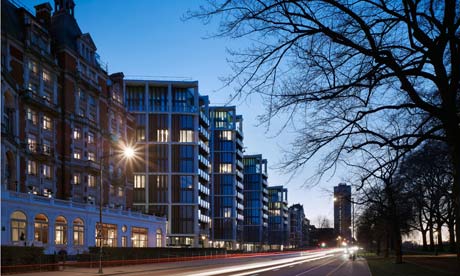
      One Hyde Park in Knightsbridge where a flat traded for £29.35 m

      Friday, April 25, 2014

      Gherkin


      PUBLISHED APRIL 26, 2014
      London's Gherkin put into receivership
      Holders of debt act to take control of the landmark building to end years of defaults
      'CUCUMBER' TOWER

      The 180-metre Gherkin, London's third-tallest building, was both ridiculed and admired when it opened as the Swiss Re tower 10 years ago. Swiss Re and Standard Chartered are among its tenants. - PHOTO: BLOOMBERG
      London
      LENDERS to the Gherkin, the conical skyscraper that's one of London's best-known landmarks, have appointed a receiver to take control of the building to end years of defaults.
      Holders of debt backed by the 30 St Mary Axe tower in the City of London financial district hired Deloitte LLP after "adverse interest rate and currency movements have caused the total senior liabilities secured by the property to increase materially", the company said in a statement.
      Receivership is similar to US bankruptcy protection.


      From Straits Times - April 26, 2014
      The cucumber shaped building at 30 St Mary Axe one of London best known landmarked opened 10 years ago this month.


      The 180M tower is fully occupied according to Evans Randall, a London base company that bought the property with a fund managed by Germany IVG Immobilien for British pound 600M in 2007.

      The building was valued at British pound 473M to 510M in 2012. ……….Brokers will be salivating in the change of ownership. 

      HSBC London HQ. 44 storey (built in 2002) in Canary Wharf is on sale and could fetch over British pound 1.1 Billion. It was sold for 1.09 Billion at the height of the property boom in 2007. HSBC has a 13 years lease on the bld. HSBC sold to Spanish property Co Metrovacesa  for 1.1B but took back ownership in late 2008 when Metrovacesa ran into financial difficulties. South Korean pension fund bought building from HSBC for nearly 800M. 

      Last year Blackstone sold its 50% stake City Broadgate complex to GIC & Dikran Izmirlian sold the More to Kuwait state property co. Both deals were reportedly priced at about 1.7B British pounds

      ·         article on the Gherkin’s iconic status ; http://archinect.com/news/article/84833004/investing-in-risk-how-the-gherkin-became-a-british-icon;
      ·         article regards CBRE’s recent appointment as thhttps://id.wsj.com/access/pages/wsj/us/login_standalone.html?mg=id-wsj&url=http%3A%2F%2Fblogs.wsj.com%2Fcanadarealtime%2F2014%2F08%2F14%2Fdesire2learn-raises-85m-to-deliver-personalized-education%2F%3Fmod%3DWSJBlog%26mod%3DWSJ_Canada_Realtime&user=gloveralst&mg=id-wsj&mg=id-wsje Gherkin’s property managers; http://www.cpexecutive.com/regions/international/cbre-tapped-to-manage-londons-gherkin/1004082796.html;

      The Race Begins


      *  Gherkin skyscraper put up for sale

      BBC News-2 hours ago
      London's Gherkin skyscraper has been put up for sale, with interest expected from Chinese, other Asian, and US buyers, estate agency Savills ...

      *  London's Gherkin to Fetch £650m

      International Business Times UK-4 hours ago
      *  London's Gherkin for sale at £650m
      Irish Times (blog)-1 hour ago