


Our astutue business accumen for several decades now playing on three continents - Asia, North America and Europe - was recently vindicated when we negotiated for the purchase of a site in Downtown San Francisco less than 18 months ago on a major site that was recently purchased by an investor from China. The North American developer would have made $150 million USD on the 'flip' of the site in a year and a half. The project is estimated to cost $1.6 bln, when completed.
Asian investment in San Francisco
225 Bush Sale
 225 Bush Street in San Francisco brought its owners nearly $140 million in two years.
The former Standard Oil Building at 225 Bush Street in San Francisco changed hands this week for the second time in two years, passing from a German investment fund to Chinese real estate group in a transaction valued at $350 million. The deal values the property at nearly 40 percent more than the last time the building changed hands two years ago.
The deal is said to be the largest office sale in San Francisco since 2012 and marks the impact that cashed-up Chinese investors are having on California’s real estate market.
Kylli Inc, a little known subsidiary of China’s Genzon Group purchased a stake in the 22-storey, 583,000 square foot structure from German investment firm SEB ImmoInvest and minority owners GEM Realty Capital and Flynn Properties. Kylli is owned by Chinese golf course developer Genzon Group together with the company’s principal.
Flynn Properties will retain a stake in the building under the terms of the deal. The transaction shows the rapid rise of San Francisco’s already healthy real estate industry, valuing the property at nearly 40 percent more than the $212 million valuation it received when the current owners acquired it from Goldman Sachs in 2012.
Current tenants of the historic office tower, which is located in an area which has rapidly become popular with US tech firms, include Groupon Inc., Zillow Inc. and RocketSpace, according to real estate consultancy JLL, which brokered the investment deal. - 2014 May 23 MICHAEL COLE
225 Bush Street in San Francisco brought its owners nearly $140 million in two years.
The former Standard Oil Building at 225 Bush Street in San Francisco changed hands this week for the second time in two years, passing from a German investment fund to Chinese real estate group in a transaction valued at $350 million. The deal values the property at nearly 40 percent more than the last time the building changed hands two years ago.
The deal is said to be the largest office sale in San Francisco since 2012 and marks the impact that cashed-up Chinese investors are having on California’s real estate market.
Kylli Inc, a little known subsidiary of China’s Genzon Group purchased a stake in the 22-storey, 583,000 square foot structure from German investment firm SEB ImmoInvest and minority owners GEM Realty Capital and Flynn Properties. Kylli is owned by Chinese golf course developer Genzon Group together with the company’s principal.
Flynn Properties will retain a stake in the building under the terms of the deal. The transaction shows the rapid rise of San Francisco’s already healthy real estate industry, valuing the property at nearly 40 percent more than the $212 million valuation it received when the current owners acquired it from Goldman Sachs in 2012.
Current tenants of the historic office tower, which is located in an area which has rapidly become popular with US tech firms, include Groupon Inc., Zillow Inc. and RocketSpace, according to real estate consultancy JLL, which brokered the investment deal. - 2014 May 23 MICHAEL COLE
225 Bush Street in San Francisco brought its owners nearly $140 million in two years.
The former Standard Oil Building at 225 Bush Street in San Francisco changed hands this week for the second time in two years, passing from a German investment fund to Chinese real estate group in a transaction valued at $350 million. The deal values the property at nearly 40 percent more than the last time the building changed hands two years ago.
The deal is said to be the largest office sale in San Francisco since 2012 and marks the impact that cashed-up Chinese investors are having on California’s real estate market.
Kylli Inc, a little known subsidiary of China’s Genzon Group purchased a stake in the 22-storey, 583,000 square foot structure from German investment firm SEB ImmoInvest and minority owners GEM Realty Capital and Flynn Properties. Kylli is owned by Chinese golf course developer Genzon Group together with the company’s principal.
Flynn Properties will retain a stake in the building under the terms of the deal. The transaction shows the rapid rise of San Francisco’s already healthy real estate industry, valuing the property at nearly 40 percent more than the $212 million valuation it received when the current owners acquired it from Goldman Sachs in 2012.
Current tenants of the historic office tower, which is located in an area which has rapidly become popular with US tech firms, include Groupon Inc., Zillow Inc. and RocketSpace, according to real estate consultancy JLL, which brokered the investment deal. - 2014 May 23 MICHAEL COLE
350 Bush
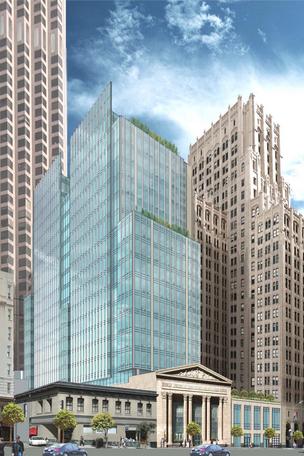
Gemdale with Lincoln Properties
For the first time in more than a decade, a new office building is coming to the financial district in San Francisco. Lincoln Property Co. just lined up a Chinese investor to start construction on 350 Bush St. and 500 Pine St., a two-building project that will total 428,000 square feet of Class A office space. The project, which had several false starts, will rise on the site of lots that have sat vacant in the middle of the financial district for three decades.
While construction crews hammer away at more than 4 million square feet of office in South of Market, no buildings have risen in the financial district since 150 California was completed in 2000. Technology tenants such as Salesforce.com, Trulia, Dropbox and Macys.com grabbed chunks of space under construction in SoMa, taking about two-thirds of the pipeline. Despite the building boom, demand keeps growing for office space in San Francisco.
"Those empty lots have been eyesores for decades," said Heller Manus Architects who is the lead designer on the buildings. "Empty lots like that create dead zones. Putting the buidlings in there will be transformative."
The 350 Bush project, entitled in 2001, went through a series of owners and roadblocks, but Dallas-based Lincoln Property and partner, Gemdale Corp., plan to begin building during the third quarter of this year.
“Together we are committed to developing an outstanding project that both we and the City of San Francisco will all be very proud of,” said executive vice president of Lincoln Property.
The taller of the two buildings, 350 Bush, consists of 19 stories and 372,000 square feet of Class A, incorporating the historic terra cotta facade and columns of the San Francisco Mining Exchange Building. The shorter building, 500 Pine St., will encompass 56,000 square foot office and retail space in five stories.
The two parcels have been vacant in the middle of a busy commercial zone for more than three decades, but not for a lack of someone trying to develop them. Heller Manus Architects started designing buildings for the sites in the 1990s when they were controlled by a partnership between Shorenstein Properties, the Swig Co. and Weiler & Arnow Management Co.
Because of zoning and shadow ordinances, the developers entitled the sites together so that 350 Bush could have a taller building on it and 500 Pine would have a shorter building with an extension of St. Mary’s park on the roof. Locking in approvals involved the city’s Planning Commission, Parks and Recreation department, historic preservation committees and the Board of Supervisors.
“It was probably the most complicated entitlement I’ve ever worked on in San Francisco,” Heller said.
Then, once developers secured the approval, the dot.com crash trampled the city’s economy and need for office space. A new real estate boom followed a few years later when Lincoln Property, a real estate developer with more than 350 million square feet under management, bought the project from the partnership for $60 million in 2007 with plans to start construction “as soon as possible.” The previous owners thought it would be easier for one owner to build out the project verses a partnership.
At about $150 per square foot, the price was one of the highest a developer paid for entitled land. Lincoln Property’s urgency dissipated, however, when another recession rolled into town leaving the project on hold again. A few years later, in 2009, the Environmental Protection Agency selected the project as a new headquarters office in San Francisco, but backed out of the plan.
“How many false starts have we had?” Heller asked. “I can’t even remember.”
Still, plans lived on and early this year, the city approved a change to the design to move the elevators to the side of the building instead of in the middle of the floors in 350 Bush. That creates a more open floor plan that technology tenants favor, Heller said.
Next, Lincoln Property brought in Gemdale, a publicly-traded, Chinese real estate development and investment firm. This will be company’s first U.S. investment.
“We are delighted with our debut into the United States with leading national developer Lincoln Property Co. in developing such an important and well-located project in San Francisco, a city which is experiencing some of the strongest office market fundamentals in the United States,” said Michael Krupa, president of Gemdale USA, in a statement. “We are delighted to have the ability to help transform the fabric of the north financial district.”
The floor plates in 350 Bush will range from 17,000 to 20,000 square feet. Building amenities include features tenants want such as bicycle parking, showers, a rooftop terrace, open layouts, and proximity to public transportation. a broker with CBRE who is handling leasing for the two buildings. Even though SoMa remains the hotspot for tech companies, "to an extent the tenants will follow the space."
While construction crews hammer away at more than 4 million square feet of office in South of Market, no buildings have risen in the financial district since 150 California was completed in 2000. Technology tenants such as Salesforce.com, Trulia, Dropbox and Macys.com grabbed chunks of space under construction in SoMa, taking about two-thirds of the pipeline. Despite the building boom, demand keeps growing for office space in San Francisco.
"Those empty lots have been eyesores for decades," said Heller Manus Architects who is the lead designer on the buildings. "Empty lots like that create dead zones. Putting the buidlings in there will be transformative."
The 350 Bush project, entitled in 2001, went through a series of owners and roadblocks, but Dallas-based Lincoln Property and partner, Gemdale Corp., plan to begin building during the third quarter of this year.
“Together we are committed to developing an outstanding project that both we and the City of San Francisco will all be very proud of,” said executive vice president of Lincoln Property.
The taller of the two buildings, 350 Bush, consists of 19 stories and 372,000 square feet of Class A, incorporating the historic terra cotta facade and columns of the San Francisco Mining Exchange Building. The shorter building, 500 Pine St., will encompass 56,000 square foot office and retail space in five stories.
The two parcels have been vacant in the middle of a busy commercial zone for more than three decades, but not for a lack of someone trying to develop them. Heller Manus Architects started designing buildings for the sites in the 1990s when they were controlled by a partnership between Shorenstein Properties, the Swig Co. and Weiler & Arnow Management Co.
Because of zoning and shadow ordinances, the developers entitled the sites together so that 350 Bush could have a taller building on it and 500 Pine would have a shorter building with an extension of St. Mary’s park on the roof. Locking in approvals involved the city’s Planning Commission, Parks and Recreation department, historic preservation committees and the Board of Supervisors.
“It was probably the most complicated entitlement I’ve ever worked on in San Francisco,” Heller said.
Then, once developers secured the approval, the dot.com crash trampled the city’s economy and need for office space. A new real estate boom followed a few years later when Lincoln Property, a real estate developer with more than 350 million square feet under management, bought the project from the partnership for $60 million in 2007 with plans to start construction “as soon as possible.” The previous owners thought it would be easier for one owner to build out the project verses a partnership.
At about $150 per square foot, the price was one of the highest a developer paid for entitled land. Lincoln Property’s urgency dissipated, however, when another recession rolled into town leaving the project on hold again. A few years later, in 2009, the Environmental Protection Agency selected the project as a new headquarters office in San Francisco, but backed out of the plan.
“How many false starts have we had?” Heller asked. “I can’t even remember.”
Still, plans lived on and early this year, the city approved a change to the design to move the elevators to the side of the building instead of in the middle of the floors in 350 Bush. That creates a more open floor plan that technology tenants favor, Heller said.
Next, Lincoln Property brought in Gemdale, a publicly-traded, Chinese real estate development and investment firm. This will be company’s first U.S. investment.
“We are delighted with our debut into the United States with leading national developer Lincoln Property Co. in developing such an important and well-located project in San Francisco, a city which is experiencing some of the strongest office market fundamentals in the United States,” said Michael Krupa, president of Gemdale USA, in a statement. “We are delighted to have the ability to help transform the fabric of the north financial district.”
The floor plates in 350 Bush will range from 17,000 to 20,000 square feet. Building amenities include features tenants want such as bicycle parking, showers, a rooftop terrace, open layouts, and proximity to public transportation. a broker with CBRE who is handling leasing for the two buildings. Even though SoMa remains the hotspot for tech companies, "to an extent the tenants will follow the space."
"We have the perfect building for the tech and creative tenant and also very good for the traditional tenant," said
The north financial district could be attractive since space is tightening up in SoMa and about three-quarters of San Francisco’s office market is made up of non-tech tenants, said an office broker with JLL.
“The north financial district is a vibrant market and has had increasing rental rates and lots of leasing activity,” he said.
Rents tend to be lower in the north financial district than in SoMa, but developers are typically seeking higher rents for new space to make up for development costs.
“With the extraordinary demand and lease up of the some of the new developments in San Francisco, certainly a developer is going to be pretty bullish on this market with good reason.”
“This cycle is an excellent time to build and smartly, (the developers) waited until the right time”
Ping An Joins Pacific Eagle
Pacific Eagle Holdings, the US subsidiary of Hong Kong’s Great Eagle Holdings, received some powerful new backing for its acquisitions of North American properties this week when the real estate investor and operator received $31.4 million from a fund operated by China’s Ping An Trust through a joint venture deal.Under the terms of the JV, Pacific Eagle (US) Real Estate Fund sold 49 percent of a company holding properties in San Francisco and Los Angeles to Ping An DeCheng Great Eagle US An Ying Fund, according to a statement from Great Eagle.
Sources familiar with Ping An’s operations say that Ping An DeCheng Great Eagle US An Ying Fund is a special purpose vehicle set up specifically to raise funding for this joint venture.
In the past two years Pacific Eagle, which is controlled by Hong Kong tycoon Lo Ka-shui, has accelerated its acquisitions properties on the west coast of the US. -- Michael Cole, 2016 March 31
View Larger Map
347,993 sq. ft. Class A office building sold in November 2013 for $181,000,000
- $520 per sq. ft
- 3.8% cap
- Sumitomo to Great Eagle Holdings
101 Second Street
View Larger Map
388,370 sq ft Class A office building sold January 2014 for $297,000,000
388,370 sq ft Class A office building sold January 2014 for $297,000,000
- $765 per sq ft
- 3% cap
- Sumitomo & Hines to Invesco
415 Mission - Salesforce Tower
View Larger Map
The 1,070 foot Transbay Tower now under construction at 415 Mission St., which will be renamed Salesforce Tower after committing to take 714,000 sq. ft.
Salesforce (NYSE: CRM) will be the anchor tenant in the glittering 1.4 million square foot skyscraper, taking nearly half the 61 floors and putting its name around the building about 100 feet above the ground. The lease, which is valued at $560 million over its 15 and a half years, starts in the first quarter of 2017, according to a filing with the Securities and Exchange Commission. Salesforce also expects to pay about $130 million in tenant improvements over time, net of allowances, and it has options to extend the lease for a total of 12 years. -- 2014 April 14 BUSINESS TIMES


