Sunday, October 13, 2013

Asian Institutional Investors


Asian Property Yields Low


Commercial real-estate yields in Asia are the lowest in the world, forcing investors to pay top prices for the highest-quality buildings, take on more risk or consider property investments outside of their regions for the first time.
Yields for centrally located office buildings are just 2.2% in Taipei, 2.8% in Hong Kong and 3.5% in Tokyo and Singapore. By comparison, they are 4.7% in New York and 3.8% in London's West End.  >> MORE

Chinese Life Insurance Companies 


Chinese institutional investors are Asia's biggest spenders on overseas commercial property

Major Chinese investors were Asia's biggest spenders on overseas commercial property last year, and insurance companies are set to lead a new wave of investment by mainland Chinese institutions.

Spending on commercial property worldwide by mainland Chinese institutional investors reached US$2.34 billion last year, and accounted for 30 per cent of all Asian overseas investment in the sector, according to data from international property consultant DTZ. 

Malaysia and Japan ranked second and third, respectively, for outbound investment.

Big Chinese investors' share of this investment jumped from 12 per cent in 2010 and 2011. It was just 7 per cent in 2009.

The strong growth rate continued into the first half of this year, during which investment in global commercial properties by Chinese institutional and company investors amounted to US$1.9 billion, or 38 per cent of total outbound Asian investment over the period.

The data is for outbound investment in commercial properties only and does not include the residential, hospitality and industrial sectors. It also excludes investments in home markets.

Head of research at property consultant DTZ, said investment has been increasing at a rapid pace because mainland Chinese capital was heading offshore because options at home were limited, liquidity was strong and the yuan's value was rising.

In a separate survey, international property consultant Jones Lang LaSalle estimated Chinese investment in commercial real estate all over the world would reach US$5 billion by the end of next year, up 25 per cent up on 2012.

Active buyers include sovereign wealth funds such as the China Investment Corp and the State Administration of Foreign Exchange's Gingko Tree Investment as well as state-owned enterprises such as China Construction Bank; companies; developers; and ultra-high-net- worth individuals.

He expects a new round of investment to be triggered by mainland Chinese insurance companies, who were only given permission to invest overseas 11 months ago. Ping An Insurance, the mainland's second-largest life insurer, paid £260 million (HK$3.1 billion) to buy the Lloyd's building in London in July.

Insurance firms are now actively studying investment opportunities overseas and the first pure mainland insurance company could trigger a deal probably early next year, according to Ness.

The insurance companies had abundant capital, which was earning a relatively low return in the country, he added, and "cannot keep all their eggs in one basket".

CBRE estimates Chinese insurers could invest up to US$14.4 billion in overseas real estate. The estimation is based on the total assets of China's national insurance institutions, which stood at US$1.2 trillion last year.

New regulations permit these institutions to invest up to 15 per cent of their assets in "non-self-use" real estate. By this measure, there is in excess of US$180 billion currently available for real estate investment, CBRE estimates.

Chinese institutional investors are expected to focus on premier office investment opportunities in gateway cities, which are capable of generating stable returns on investment in the short term. Targets are likely to include prime offices in cities such as London and New York, according to CBR





Thursday, October 10, 2013

Asian REIT and Business Trusts


PUBLISHED NOVEMBER 12, 2013
Closer scrutiny of Reits, trusts IPOs if rates rise
But market players see current window for more of such deals in upcoming IPO pipeline
Sgreitss121
The tapering of quantitative easing (QE) is expected to be followed by a rise in interest rates, which would affect the borrowing costs of Reits and business trusts as many are highly geared - PHOTO: SPH
[SINGAPORE] Real estate and business trust offerings may be a harder sell in the coming months, as the market shifts towards expectations of higher interest rates.
While there is still an appetite for the initial public offerings (IPOs) of real estate investment trusts (Reits) and business trusts, interest will become more selective given the overhang of a future reduction in US monetary stimulus.
The quality of sponsors and assets and the growth profile of the trust will be more closely scrutinised, said investment bankers.
"There's no denying the fact that we are in a new environment, and risk-free rates are going to go up," said Edward Lee, Deutsche Bank's head of South-east Asia equity capital market.


Macau

Louis XIII raises $133.5 million for Macau project
An artist's image of the Louis XIII hotel and casio, which is designed by New York architect Peter Marino.

The equity/CB deal comes on the back of a $411 million capital raising in January and will go towards the funding of an ultra-luxury casino and hotel project on the Cotai strip.

By Anette Jönsson | 11 November 2013 
Keywords: placement | convertible | casino | gaming | luxury | stephen hung |paul y engineering | clsa | deutsche bank
Louis XIII Holdings, the company that was formed early this year and is in the process of developing a highly exclusive boutique casino and hotel in Macau, has raised an additional $133.5 million towards the funding of the project through a combined sale of equity and zero-coupon convertible bonds.

The deal includes a share placement of about HK$735 million ($94.6 million) that was sold to investors through an accelerated bookbuild after the market closed on Thursday last week and a $38.7 million Hong Kong dollar-denominated CB that will be taken up by the Ontario Teachers’ Pension Plan. The OTPP also bought $130 million worth of CBs when the company raised its first round of capital in January this year.

Louis XIII raised $411 million in January, split between $256 million of equity and $155 million of CBs. This was a massive undertaking given that the company had a market cap of just $84 million at the time. The overall deal came with an upsize option of about $200 million that wasn’t exercised and hence the company had been expected to return to the equity market at some point to raise more funds.

The total development cost of the Macau casino project is currently estimated at about $1 billion, which is up from an earlier estimate of about $774 million in January. Including the $133.5 million raised last week, the company does now have enough capital to fund the equity portion. The rest will be covered by bank loans.

In an announcement issued on Thursday last week, Louis XIII said it is in also “advanced discussions” with a mainland China-based bank to obtain a credit facility of about HK$3 billion ($387 million) as well as a working capital facility of about HK$1 billion ($129 million), subject to final terms and documentation. Assuming the loans come through, the company will have raised a total of about $1.06 billion of equity and debt in less than 12 months, based primarily on a vision and a few blueprints of an ultra-luxury project that is scheduled to open in early 2016.

By now, the construction has started, however, and earlier this week the company said it has appointed internationally acclaimed architect Peter Marino as exterior design theme architect and interior design theme consultant. Marino runs his own New York-based architecture, planning and design firm and according to a press release he has designed the flagship stores of many of the world’s leading luxury brands, including Chanel, Louis Vuitton, Christian Dior, Ermenegildo Zegna, Graff, and Loewe.
“We are absolutely thrilled to have Peter on board,” Louis XIII’s chairman Stephen Hung said in the release. “He has a unique ability to bring together luxury and excitement in ways that continually surprise and delight. Peter has created an iconic tower for Louis XIII that is elegant, timeless and perfectly captures the concept of extreme luxury.”

Louis XIII was created early this year when Hong Kong-listed construction and engineering firm Paul Y Engineering Group (PYE) teamed up with Hung and his son and shifted most of its business focus towards this particular Macau project. PYE is still involved in construction, but distributed 49% of its construction and engineering subsidiary to its existing shareholders through a distribution in specie and changed its name to Louis XIII Holdings, leaving no doubt about where its priorities lie.

The new shares were offered at a fixed price of HK$8.23 apiece, which translates into a 15.1% discount versus Thursday’s closing price of HK$9.70. The share price has multiplied since the January placement however, which was done at a price of HK$0.68 per share.

The deal consisted of approximately 89.2 million new shares, but because the total number of shares exceeds the 20% of the existing share capital that the company can sell without a special approval from its existing shareholders, the deal was split into two parts. The first part, accounting for 20% of the existing share capital and about $76.5 million, has been allocated already, while the second part, which accounts for 4.8% of the existing share capital and about $18.1 million, will be distributed to investors by mid-December after shareholders have had a chance to approve it at a special general meeting.
According to the source, the combined placement was comfortably covered and attracted more than 30 investors. They buyers included a combination of long only investors and hedge funds as well as some gaming specialist funds. The deal also received good support from the company’s existing CB holders.
The new CB will have similar terms to the one issued earlier this year and will mature on the same day: February 5, 2025. It has a zero percent coupon and yield and a conversion price of HK$8.23, which is equal to the latest placement price. The initial CB is convertible at a price of HK$0.68 per share, which corresponds to the January placement price.

The deal was seemingly well received by the market. Louis XIII’s share price, which closed at its highest level since the January capital-raising just before the Thursday transaction, fell 8.1% on Friday. This was significantly less than the 15.1% placement discount and the stock closed well above the HK$8.23 placement price at HK$8.91.   

The Louis XIII boutique hotel is described as a seven-star property that will outdo all other hotels in Macau in terms of luxury. It will have 236 rooms, or suites rather, that will rent for a minimum of HK$10,000 per night. There will be 66 gaming tables with a minimum table bet of about HK$5,000 and the attached retail shops are proposed to be by appointment only.

It will cater primarily to wealthy individuals who use their own money to gamble, as opposed to the so called VIP clients who typically use credit provided by junket operators when they hit the tables.
Marino noted that when he designed the exterior of the hotel he imagined a royal red robe wrapped around a crystal core that rises from a 20-metre diamond – the most perfectly formed geometric material on the planet.

The project is the vision of Stephen Hung, who is a former co-head of investment banking for Asia at Merrill Lynch and known as something of a deal-maker in Macau. Among other things he is a major shareholder in the Rio Hotel & Casino. He also owns 12.4% of Louis XIII, making him the single largest shareholder after ITC Corp.

The deal was jointly arranged by CLSA and Deutsche Bank.    --  FINANCE ASIA 2013 October


Wednesday, October 9, 2013

Galiano

Waterfront

One of the gulf islands, easily accessible from Vancouver, we co-own 100 acres of waterfront in these pristine waters and fresh air.

Take a look at this pod of whales this summer.


Wednesday, October 2, 2013

Barbados

OUR DIARY

太太's piece of heaven on earth.    Our own private beach front home to share with Best Friends.   


L's came in from New York; S's via London, and Richard & Ivy travelled 31 hours from Hong Kong.  

Twice we were hosted by the always affable and generous host of Cove House Springs.  Ajmal has a hefty collection of Petrus.


Aj's Place in Barbados


Let me see if I can remember the list of celebrity entertainers who have rented this amazing piece of real estate:  Kian Egan, Mariah Carey, Simon Cowell...

i love best that Prince Harry with Aj was photographed in Hello! magazine in the UK.  

This was an experience of great minds exchanging global ideas.   

What an invigorating business lesson!
An amazing introduction to Barbados.  Much thanks to my hosts & good friends.


When we left this amazing piece of heaven on earth, 90 turtle eggs were laid at the gate from the beach.   Global Asians especially consider this an auspicious sign.  


Monday, September 30, 2013

Sky Vue


Launch in Singapore


Sky Vue sells 80% of the project on launch day


Artist’s impression of Sky Vue
Sky Vue, a 694-unit 99-year leasehold residential project near Bishan MRT, reportedly sold 410 of the 505 units released on its first day, at an average price of $1,500 per square foot – this translates to a sell-through ratio of around 80% of the units launched and 60% of the entire project. Most of the units sold were small one- and two-bedroom units, with the average price of a one-bedroom units around $750,000 while that of a two-bedroom units being $933,000.
The developers, CapitaLand and Mitsubishi Estate Asia, managed to keep the total cost of the units under the magical $1 million (and thus appeal to mass market investors and upgraders) by shrinking the size of the units. One-bedroom units ranged in size from 484 to 592 square feet, versus next door Sky Habitat’s 635 to 958 square feet for one-bedroom units. Sky Vue’s two-bedroom units ranged from  678 to 915 square feet in size.


Sky Vue sells individuality to young Singaporean home buyers


A campaign launched in Singapore today to promote new property development Sky Vue.
Jointly developed by CapitaLand and Mitsubishi Estate Asia in Bishan on Singapore’s city fringe, the campaign is targeting singletons, young couples and families.
The idea behind the campaign is to show that buyers can retain their own sense of individuality while living at Sky Vue.
Fiona Bartholomeusz, MD of Fomul8, the agency behind the campaign, said: “When people are faced with many choices for what is a very big decision in life (buying a home), what ultimately stands out is an emotional attachment to how that home would make them feel. Location, luxury, amenities have become almost expected by Singapore standards. What is missing is an emotional sell so that people see themselves making a home there and being happy, and that ultimately is what we all seek in the places we choose to live in.”

Well done Fiona!!    Congratulations.


Sunday, September 8, 2013

Global Monopoly


China-based acquisitors are new to this game but have managed to make a big splash like China Anbang's purchase of the Waldorf Astoria in New York; Shanghai Greenland's purchase of Hertsmere site in Canary Wharf in London, and elsewhere.  

Now they are trying second tiered cities like Seattle, Los Angeles, Sydney & Canberra, and Toronto.   There is a new found confidence with these Chinese investors as their wealth has increased in the last decade and they are not shy to take on developments.

There is so much new wealth generated in the last ten years and a rising middle class which is the world's growing fastest consumer market.

Chinese Acquisitions

Chinese global cross-border acquisitions topped $54.3 billion this year, up 35 percent, Bloomberg available data show. Shanghai-based Fosun International Ltd. (656) in January outbid a U.S. buyout firm for Portugal’s 80 stake in Caixa Geral de Depositos SA’s insurance unit for 1 billion euros. Hong Kong-based Cosco Pacific Ltd. (1199) is among bidders of a state-fund stake in Piraeus Port Authority (PPA) while a Chinese venture is seeking a majority in Athens International Airport.    --  2014 October 12   BLOOMBERG


The “Next 15″ will drive 80pc of emerging market growth by 2025: report

By 


July 30, 2014

Sixty percent of the world's population live in the Next 15
Sixty percent of the world’s population live in the Next 15
As emerging markets continue to grow, 600 of the world’s top cities will be responsible for nearly 85 percent of global economic growth by 2025, according to a new report by McKinsey.
McKinsey suggests that through mass urbanization there will be 60 megacities, double that of today, accounting for a quarter of global GDP. To target these areas of growth, luxury brands must adjust strategies to include cities that may not yet be on their radar to ensure that they have a presence as new markets begin to flourish.
“It is hard for a brand entering a new emerging market to do everything at once,” said Sophie Marchessou, associate partner at the apparel, fashion & luxury group at McKinsey, New York.

“Resources are often time limited (management attention, investment available…), so it is better to have a disciplined approach to target in priority cities that matter most,” she said. “The largest cities in an emerging market also usually have a spillover effect on smaller cities, so by being present in the right cities, you improve your brand awareness overall.

“[Economic rebalancing] will affect [marketers] in many ways. There will be a constant conversation in companies about resource allocation, offer tailoring, brand building, etc.”
McKinsey’s LuxuryScope “The glittering power of cities for luxury growth” report used a methodology called CityScope that draws upon economic and socio-demographics for more than 2,600 cities around the world. McKinsey’s data goes down to the city level to predict growth and can be used by luxury brands to determine how to approach growth opportunities based on location.
Finding a city
For the first time since the Industrial Revolution, the world is undergoing a significant economic transformation. For example, modern-day China is urbanizing at a speed 10 times faster than the urbanization of 19th-century Britain, thus making Asia the world’s “economic center of gravity.”
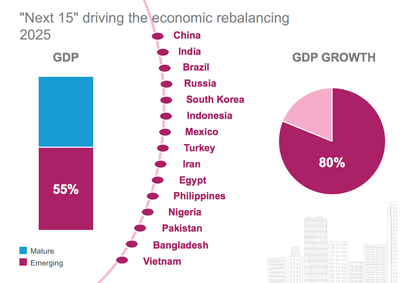
Growth extends beyond China and the other BRICs to include what McKinsey calls the “Next 15.” These additional 11 countries are set to drive 80 percent of emerging market growth even though they only account for 25 percent of the global GDP.
These regions include South Korea, Indonesia, Mexico, Turkey, Iran, Egypt, the Philippines, Nigeria, Pakistan, Bangladesh and Vietnam. With 60 percent of the world’s population living within these countries, brands now have opportunities for growth outside the traditional established markets.
mckinsey.next 15 chartMcKinsey’s LuxuryScope Next 15 chart 
Although a significant amount of these emerging city markets are located in China, brands must extend their retail footprint within the Next 15’s smaller cities where growth potential is high. The 100 highest-growing cities such as Pune, India, Harbin, China and Luanda, Angola, will grow significantly in comparison to megacities such as Shanghai and Moscow.
McKinsey suggests that within the next 15 years the approximately 400 “second-tier” cities will yield wealth equivalent to the United States economy today.
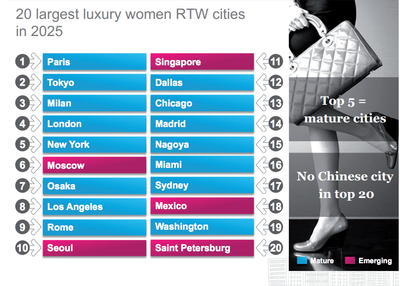
Though other cities are growing, this does not necessarily mean the irrelevance of established markets. In terms of women’s ready-to-wear in the 20 largest city markets in 2025, for example, no Chinese cities make the cut and no emerging market cities fall within the top 5.
mckinsey.RTW Next 15 chartChart showing the 20 largest luxury women RTW cities in 2025, McKinsey 
Western mega cities will benefit from “riding the wave of growth” as emerging countries develop and their maintained status will be driven by “cultural fit” and factors determined by category and price point. This is especially true for women’s luxury ready-to-wear, dominated by established fashion capitals such as Paris, Milan and New York.
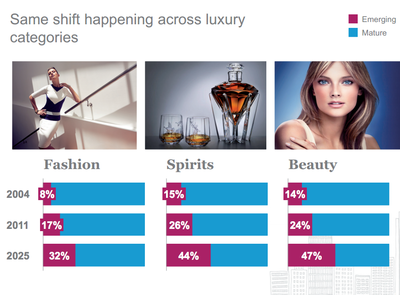
Growth in emerging market cities is already apparent in luxury sectors such as fashion, spirits and beauty. Research suggests that luxury women’s wear will grow from less than 10 percent a decade ago to 32 percent in 2025, while high-end beauty products will double to represent 47 percent.
mckinsey.fashion beauty spirits Next 15McKinsey chart showing shift in emerging marekt categories
Although this growth signals that emerging markets are growing three times faster than their mature counterparts, moving into these areas is less advanced and will enable brands to make an impression much easier than they would in an established city.
Ninety percent of global luxury growth will result from consumers living in the top 20 apparel growth cities, seven of which are found in the Next 15 countries. China leads the way by driving half of this growth, while the remaining markets account for one-fifth of luxury consumers by 2025, a population four times that of the United Kingdom.
Growth spurt
To find success in these new market cities, McKinsey suggests a “city-by-city” strategy that allows brand to readjust business models, resource allocations and organizational structure. McKinsey sees this approach as a “compass for companies seeking to navigate the vast sea of emerging markets” whether in Belo Horizonte, Brazil or Wuhan, China.
Five main touchpoints should be tackled before a brand selects to enter an emerging city market. These include identifying the right go-to-market model per location, determining the need for local customization, ensuring standards in global customer service, gauging the need for organizational alterations and how to allocate resources.
These tactics have been undertaken by other brands that have entered emerging markets before the floodgates were opened, despite the risk.
For example, Estée Lauder Cos.’ expansion practices are marked by entering emerging markets ahead of other companies despite the increased risk, according to the “Building Empire” session May 13 at the FT Business of Luxury Summit.
Understanding risk tolerance is a must when embarking on any new project, especially when setting up shop in marketplace that is still developing. As one of the world’s most valuable brands, Estée Lauder strives to introduce its products ahead of competitors to better understand emerging markets (see story).
Beyond general market demographics, brands entering a new city location must have a handle on local culture, especially in the beauty sector.
For beauty marketers targeting consumers in emerging markets, it is essential to understand the grooming habits and preferred personal care products in the country at hand, according to a survey conducted by Euromonitor International.
In 2013, global sales of skin care products totaled more than $107 billion and the hair care market totaled $77 billion. These global sales figures, estimated to grow by 20 percent between 2014 and 2018, are reflective of the time, money and effort consumers spend on their appearances (see story).
Strategies must be outlined per country, rather than an oversweeping global tactic for all.
“The power of mega cities in the future,” Ms. Marchessou said. “Many cities will be as large as countries – Tianjin will be the size of Sweden, Shanghai will be the size of Poland and Portugal together.
“It varies slightly by category but for luxury women ready to wear for example, Moscow, Singapore, Mexico City, Seoul and St. Petersburg will be in the top 20 largest cities by size,” she said. “Beijing or Shanghai don’t make it to the top 20 but are among the fastest growing.
“What those cities share is a growing upper class that drives the purchase of luxury apparel and potentially some tourist spend [which is] usually more relevant for developed cities though.
Authors: Aimee Kim, partner at McKinsey’s Seoul office, Nathalie Remy, principal and co-leader of McKinsey’s apparel, fashion & luxury group, Jennifer Schmidt,  partner and Leader of Americas’ 
apparel, fashion & luxury group at McKinsey, NJ and Benjamin Durand-Servoingt, engagement manager at McKinsey, Paris.


PUBLISHED FEBRUARY 03, 2014

More firms venturing into overseas property
Australia, UK, US hot spots; US$3.5b invested abroad in first 9 months of last year

Firms have ramped up their geographical diversification efforts in recent months in a bid to escape Singapore's prohibitive property cooling measures - 


[SINGAPORE] Firms have ramped up their geographical diversification efforts in recent months in a bid to escape Singapore's prohibitive property cooling measures. In the opening weeks of January alone, Aspial Corporation unveiled two acquisitions in Australia, Keppel Land agreed to purchase land in Indonesia and CapitaLand picked up yet another plot in China.
Australia, the United Kingdom and the United States have been firms' favourite hot spots. Several companies, including Hiap Hoe, AIMS AMP Capital Industrial Reit, Aspial, and Suntec Reit, picked Australia for their first overseas acquisitions.
Hiap Hoe, for instance, bought a 40,489-square-foot site in Melbourne, which it intends to develop into a 425-unit project, and then quickly went on to snap up a commercial building at 380 Lonsdale Street and a retail and office property at 206 Bourke Street. The three acquisitions cost the company about A$177.6 million (S$198.4 million). Aspial bought a freehold commercial building in Melbourne for A$41.5 million, soon followed by a separate commercial building also in Melbourne for $42.3 million. It intends to redevelop the latter site into what will be the tallest building in the city, subject to aviation clearance.
Among Reits, AMP Capital picked up a 49-per cent stake in Optus Centre, a business park in Sydney, for A$184.4 million, while Suntec Reit bought 177-199 Pacific Highway, a freehold land and property with a 31-storey Grade A commercial tower that is targeted for completion in early 2016. These were the first overseas acquisitions for both Reits.
Andrew Bird, chief investment officer (property) at AMP Capital, said he expected investment interest in Australian property to continue to remain high, particularly for the office and residential sector.
"The attraction of Australia (lies in its) high yield relative to other markets globally," said Mr Bird, noting that yields for prime property in Australia are about 6 per cent.
"When global investors look at property markets on a relative basis, they look at Australia and they see the high starting yield. And while the economy has softened a bit - the mining boom has slowed down - we are still looking at GDP growth of about 2.5 to 3 per cent," said Mr Bird.
The above two factors, plus sustained population growth through organic growth and immigration, are reasons why interest in Australia will likely remain high. That developers are looking elsewhere is perhaps not surprising, given plunging sales at home.
"New and adjusted local government policies in recent years that were meant to prevent a real estate asset bubble from forming and bursting, have, somewhat, limited the opportunities here for investors and developers," noted Chia Siew Chuin, director for research and advisory at Colliers International. "In addition, the property playing field in Singapore has matured with many players bringing more diversity into the game, hence increasing the level of competition," she said.
According to data released by DTZ, close to US$3.5 billion was invested overseas by Singapore-based investors in the first nine months of 2013.
Notably, this figure does not take into account GIC's 50 per cent stake in London's Broadgate business district, a retail and commercial estate of 17 office buildings. While the consideration for GIC's purchase was not disclosed, reports placed the price tag at around £1.7 billion (S$3.56 billion) - believed to be a record for a central London property.
London has emerged a popular investment spot thanks to its reputation as a stable financial centre, said CBRE's Chris Brooke, executive managing director for Asia.
"Asian developers buying institutional Grade A office assets in London are driven by the feeling that London is a stable financial centre, offers reasonable yield, and is a long-term core holding. There is also the desire to have a flagship property in London," said Mr Brooke.
"(On the residential front) it is a good market to be building high quality residential homes notwithstanding the capital gains tax. The feeling is that demand will remain, even though it may trail off a little bit," he added.
City Developments Limited (CDL) and Oxley Holdings are among the firms that made forays into the London market in the last 12 months - CDL via a freehold plot near Harrods in Knightsbridge, which it intends to redevelop, and Oxley Holdings via a mixed development site at London's Royal Wharf.
Other firms also entered the fray. Local construction group Lum Chang added a London hotel near the tourist attractions of Hyde Park and Kensington Gardens to its growing list of London properties last year.
Property in the US also received its fair share of interest. SingHaiyi group - previously known as SingXpress Land - snapped up two distressed commercial projects in the US in the last few months, after Neil Bush, the brother of former US president George W Bush, was brought on board as non-executive chairman of SingHaiyi.
The two projects, Tri-County Mall in Ohio and Vietnam Town in California, were picked up for US$45 million and US$33.1 million respectively. Earlier this month, the group said that it is in talks to acquire another two to three assets in America.
Separately, OUE picked up California's tallest building - the US Bank Tower in Los Angeles - for US$367.5 million, while earlier this year GIC sealed a deal to buy office space in New York's Time Warner Centre with two partners, the Abu Dhabi Investment Authority and US real estate firm Related Companies, for US$1.3 billion.
While many local firms have been acquiring plots overseas, one of the most active is local developer Oxley Holdings, which now has ventures in Malaysia, Cambodia and China.
Following its first move abroad in May last year, in which it bought a firm with rights to a mixed-use site in Kuala Lumpur, Oxley Holdings has assembled an impressive portfolio of plots through a combination of joint ventures, development right agreements and acquisitions.
In January, the group said it signed a framework agreement with Sepang Goldcoast and Sepang Bay to develop land. The latter two hold interests in two parcels of 99-year-leasehold land with an aggregate area of about 47.3 hectares in Sepang. The joint-venture agreements entitle Oxley Treasure to 85 per cent of the gross development value of the developments on the land.
As to the future for acquisitions, some experts urge caution as the global economic recovery proceeds.
Speaking on the sidelines of the DTZ Annual Property Outlook Seminar 2014 earlier this month, Dominic Brown, head of South East Asia/Australia and New Zealand Research, said: "From an investment perspective, the main point is that (globally) property is not expected to get any more attractive on a relative value basis in the near term ... This stems from the fact that upside risks are now increasingly likely as the global economic recovery starts to gather momentum. This is a big shift from last year when a lot of focus was on what might happen if the eurozone broke up."
HEADLINES